What are some online chart calculators that you recommend that account for the solar time accurately despite time zones and daylight savings?
Search ranking alone cannot establish which calculator is accurate; a key difference is the clock used for the Day and Hour pillars, so set aside three minutes to check it yourself. Sources: Own test ledger; Unchanged local implementation.
Enter the same synthetic date, recorded time, time zone and longitude, check the historical UTC offset and UTC instant, then toggle solar time and compare the Day and Hour results with the eight-case ledger below. Sources: Own test ledger; Unchanged local implementation.
Time zone: which UTC instant did the clock mean?
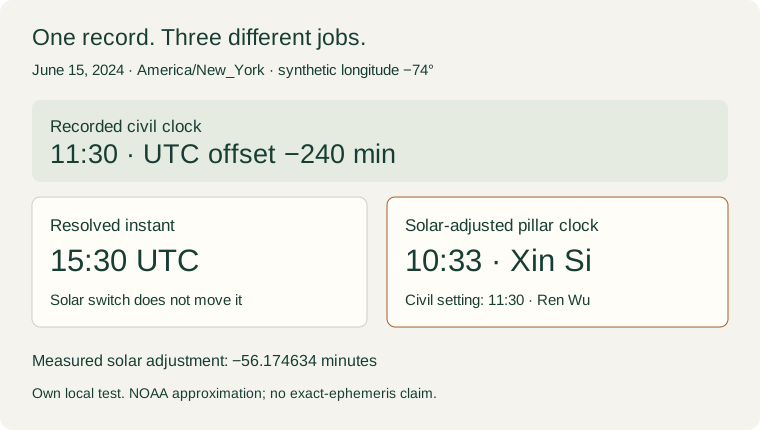
For this test, America/New_York resolves June 15, 2024 at 11:30 to 15:30 UTC, with an offset of −240 minutes. The named zone supplies the date-dependent offset. In this implementation the resolved instant feeds the Year/Month solar-term calculation; Day/Hour use the selected civil or solar-adjusted clock. Sources: Own test ledger; Unchanged local implementation; IANA North America rules.
Changing only the zone to UTC turns that same written 11:30 into 11:30 UTC: the instant moves four hours earlier (11:30 − 15:30 = −240 minutes). Yet all four displayed pillars stay the same in this deliberately chosen case. Matching chart characters therefore did not detect our bad zone input; the UTC receipt did. Sources: Own test ledger.
Daylight saving: is the civil offset already adjusted?
US daylight saving advances the clock by one hour. For our date, the New York test uses UTC−04:00; the synthetic fixed-standard-time reference uses UTC−05:00. Their offset difference is (−240) − (−300) = 60 minutes. DST belongs to resolving the recorded civil time, not to a second manual deduction after the named zone has resolved it. Sources: NIST DST rules; IANA North America rules; Own test ledger; Unchanged local implementation.
Our pair makes that one hour visible: 11:30 in America/New_York and 10:30 in Etc/GMT+5 both resolve to 15:30 UTC. Etc/GMT+5 means UTC−05:00 in this tested identifier. With solar time off, their different selected clocks yield Ren Wu and Xin Si Hour pillars respectively; equal UTC instants alone do not promise equal civil-clock Hour pillars. Sources: Own test ledger.
If we first subtract an hour ourselves and still enter America/New_York, the input becomes 10:30 and the resolved instant becomes 14:30 UTC, one hour earlier than intended. With solar time on, its displayed clock becomes 09:33 instead of 10:33. The Hour pillar happens to remain Xin Si in both of these two outputs, so checking only that pillar also misses this error. Sources: Own test ledger.
Solar time: which clock is used for Day and Hour?
The local implementation uses the NOAA approximation for equation of time and applies: solar adjustment in minutes = equation of time + 4 × east-positive longitude − historical UTC offset in minutes. Longitude and equation of time change the selected pillar clock here; enabling this switch does not change the resolved UTC instant. The formula is an approximation, not an independently validated exact ephemeris. Sources: NOAA solar equations, page 1; Unchanged local implementation; Own test ledger.
At the deliberately synthetic longitude −74°, our 15:30 UTC case has equation of time −0.174634 minutes. The adjustment is −0.174634 + 4 × (−74) − (−240) = −56.174634 minutes. Solar OFF displays 11:30 with Ren Wu; solar ON displays 10:33 with Xin Si. Year, Month and Day remain unchanged in this pair. These are this fixture’s outputs, not a universal one-hour rule. Sources: Own test ledger.
Move only the synthetic longitude from −74° to −73°, keeping the instant and named zone fixed: the measured correction increases by exactly 4 minutes, from −56.174634 to −52.174634. The displayed solar clock moves from 10:33 to 10:37; the Hour pillar stays Xin Si. This isolates longitude from DST instead of treating both changes as one correction. Sources: Own test ledger.
Turn solar time on for both equivalent inputs in our daylight/standard pair. The daylight-clock route is 11:30 − 56.174634 minutes; the standard-clock route is 10:30 + 3.825366 minutes. Both display 10:33 and produce the same four pillars. This controlled agreement checks our implementation’s internal handling of the civil offset; it does not certify another tool or astronomical precision. Sources: Own test ledger.
Our same-instant UTC reference is another useful trap: 15:30 in UTC and 11:30 in New York share 15:30 UTC, but with solar time off their Hour pillars are Jia Shen and Ren Wu. To compare calculators, record the pillar-clock convention as well as the UTC instant; do not “fix” a difference by silently replacing the birth-place clock with UTC. Sources: Own test ledger.
Reproduce the eight-case check
All rows use Gregorian June 15, 2024, known time, male, midnight day boundary and synthetic longitude −74°, except the explicit −73° sensitivity row. The ledger contains every input and all four pillars. It was run in Node using the same unchanged browser calculation code; it is a local engine test, not an independent validation of the astrological model. Sources: Own test ledger; Unchanged local implementation.
| Case | Zone / clock entered | UTC | Pillar clock | Hour |
|---|---|---|---|---|
| civil | America/New_York / 11:30 / solar OFF | 15:30 | 11:30 | Ren Wu |
| solar | America/New_York / 11:30 / solar ON | 15:30 | 10:33 | Xin Si |
| wrong-zone | UTC / 11:30 / solar OFF | 11:30 | 11:30 | Ren Wu |
| same-instant-utc | UTC / 15:30 / solar OFF | 15:30 | 15:30 | Jia Shen |
| standard-clock | Etc/GMT+5 / 10:30 / solar OFF | 15:30 | 10:30 | Xin Si |
| standard-solar | Etc/GMT+5 / 10:30 / solar ON | 15:30 | 10:33 | Xin Si |
| wrong-manual-subtraction | America/New_York / 10:30 / solar ON | 14:30 | 09:33 | Xin Si |
| longitude-step | America/New_York / 11:30 / solar ON | 15:30 | 10:37 | Xin Si |
What this recommendation does and does not establish
Choose a tool whose receipt lets you reproduce these distinctions. Our results support this inspectable workflow for these synthetic cases; they do not certify another tool or every historical date. For an unknown time or a clock-change gap, keep the uncertainty explicit rather than inventing a precise input. Sources: Own test ledger; Unchanged local implementation.
- Own synthetic input/output ledger and engine hash — eight cases, local runtime versions and measured differences.
- Actual local implementation — named-zone resolution, solar equation, Year/Month instant and Day/Hour clock paths.
- IANA time-zone database, North America — America/New_York and US seasonal rules; use historical rules for the actual date.
- NIST DST rules — the US one-hour clock change; not a universal rule for every country.
- NOAA General Solar Position Calculations, page 1 — equation-of-time approximation and solar-time offset formula.
The three-minute time check
Enter the same synthetic date, recorded time, time zone and longitude, check the historical UTC offset and UTC instant, then toggle solar time and compare the Day and Hour results with the linked eight-case ledger.
- Time zone. Keep the recorded local clock time and select the birth-place zone for that date. Record the historical UTC offset and resolved UTC instant. Time-zone reference.
- Daylight saving. Check whether the named zone has already included the seasonal offset; do not subtract it again. US DST reference and our tested offset pairs.
- Solar time. Hold the inputs fixed, switch solar time off and on, then record the pillar clock and Day/Hour results. In this calculator that switch changes the selected clock, not the resolved UTC instant. Solar-time formula and our measured cases.
Read the worked answer and eight-case ledger ↗Find related time-setting pages ↗