KEEP THE UNCERTAINTY VISIBLE
Can you use a Bazi calculator without a birth time?
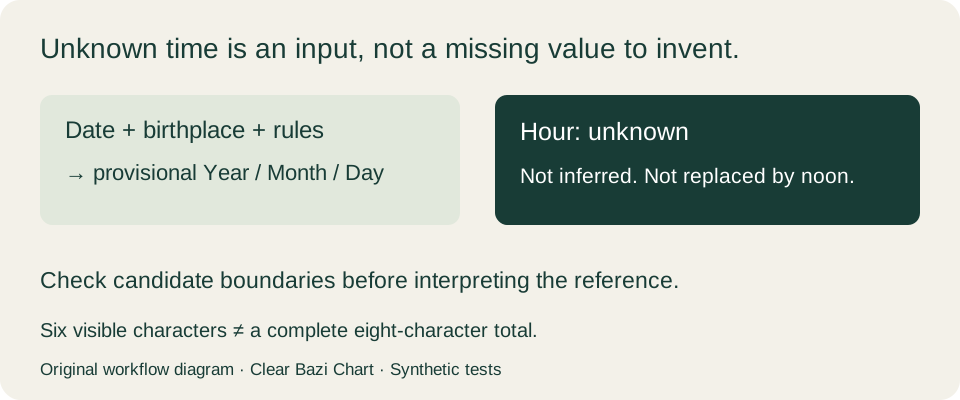
Yes, you can calculate a partial chart. Select “I don’t know my birth time” and leave the Hour pillar unknown. Do not enter noon as though it were documented. The displayed Year, Month and Day pillars are reference results: near solar-day or solar-term boundaries, even those pillars can vary across possible birth times.
What the unknown-time option actually does
Our unchanged calculator uses noon internally to generate a reference, omits the Hour pillar, and counts six visible characters instead of eight. The noon reference is a computational anchor, not a recovered birth time. It also samples the civil day every 30 minutes and lists the Year / Month / Day combinations it encountered.
Test one: a missing hour changes what the element total means
We ran Gregorian June 15, 1990, Beijing, Male, Asia/Shanghai, longitude 116.39723° east, true solar time on and the midnight day boundary. The first run selected unknown time; the comparison deliberately entered 12:00 as a known time. Both are synthetic tests. Choosing a date and city is still necessary when the hour is unknown.
| Output | Unknown time | 12:00 entered as known |
|---|---|---|
| Year / Month / Day reference | Geng Wu / Ren Wu / Xin Hai | Geng Wu / Ren Wu / Xin Hai |
| Hour | Omitted | Gui Si |
| Visible counts: Wood, Fire, Earth, Metal, Water | 0, 2, 0, 2, 2 | 0, 3, 0, 2, 3 |
| Visible characters counted | 6 | 8 |
In the unknown-time run, the half-hour scan encountered both Geng Xu and Xin Hai as Day pillars while Year and Month stayed the same. With true solar time off, the same date’s scan encountered only Xin Hai under the midnight rule. The local clock and the solar-adjusted day are different boundaries; the displayed noon Day Master should therefore remain provisional in the solar-time run.
A zero in a partial visible-element count does not establish that an element is absent from the complete chart. The missing Hour may contribute it, and hidden stems are a separate tally. This test illustrates the denominator change; it does not measure which element someone needs or establish a personal recommendation.
Test two: unknown time can affect Year and Month too
For Gregorian February 4, 2024, Beijing, Male, Asia/Shanghai, unknown hour, true solar time off and the midnight rule, the displayed noon reference was Gui Mao / Yi Chou / Wu Xu. The scan also encountered Jia Chen / Bing Yin / Wu Xu. This is a concrete example of a date that contains a traditional solar-term year/month transition in this engine; knowing the date alone does not select a single Year and Month.
| Candidate | Year | Month | Day |
|---|---|---|---|
| Reference / earlier part | Gui Mao | Yi Chou | Wu Xu |
| Later part | Jia Chen | Bing Yin | Wu Xu |
The scan is a warning system, not a complete interval solver: a 30-minute grid can miss a short interval near a boundary. It does not recover the birth hour or certify that all candidate charts have been enumerated. If you have a documented morning or afternoon interval, calculate its possible times separately and retain the interval as evidence.
Which results should stay provisional?
Is the strength label final?
No. It uses the available pillars and the site’s disclosed weighted model. Omitting the Hour changes that model’s inputs, and a boundary-sensitive Day Master can change its basis. Treat the partial label as a reference rather than a diagnosis.
Can I trust an exact luck-onset date?
Not as an exact result when the birth time is unknown. The displayed onset and current-cycle labels use the noon reference. Preserve the provisional label; neither an exact-looking date nor a familiar life event recovers the missing record.
A practical way to use the partial chart
- Verify the recorded calendar, date and birthplace time zone.
- Select unknown birth time; keep the Hour blank.
- Read the uncertainty notice before interpreting the Day Master or totals.
- Keep solar-time and day-boundary settings visible when comparing results.
- If evidence narrows the time window, test candidates without silently turning an estimate into a fact.
Reproduce the checks and inspect the limits
These results were measured on October 27, 2026 using this site’s bundled lunar-javascript 1.7.7 and existing unknown-time wrapper. The wrapper samples local times; the library supplies traditional calendar calculations. Historical time-zone data comes from the runtime. The cases verify the software behavior described here, not the truth of traditional interpretations. See our DST test for skipped and repeated civil times.
- Download the synthetic test inputs and observed outputs.
- Calendar engine source.
- NOAA solar-time equation — the approximation used by this tool.
- Calculation conventions and unknown-time limits.