A SOLAR INSTANT, NOT A WHOLE-DAY LABEL.
When does the Bazi year change at Li Chun?
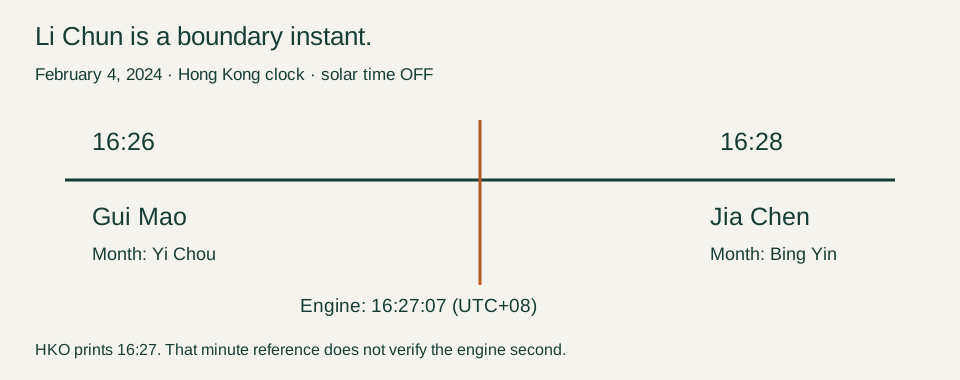
This calculator changes the Year pillar at the Li Chun solar-term instant, not at January 1 or Lunar New Year. In our 2024 Hong Kong test, 16:26 on February 4 still gives Gui Mao; 16:28 gives Jia Chen. The exact year, time zone and calculation convention matter.
Two minutes that change the Year and Month pillars
We ran the same fabricated February 4, 2024 birth twice, at 16:26 and 16:28 in Asia/Hong_Kong. The inputs were Gregorian, known time, male, longitude 114.1694° east, true solar time OFF and midnight day boundary. Only the minute changed. The Year and Month pillars changed together; Day and Hour stayed the same in this paired test.
| Local time | UTC | Year | Month | Day / Hour |
|---|---|---|---|---|
| 16:26 | 08:26 | Gui Mao | Yi Chou | Wu Xu / Geng Shen |
| 16:28 | 08:28 | Jia Chen | Bing Yin | Wu Xu / Geng Shen |
Separate the reference minute from the engine second
The Hong Kong Observatory’s February 2024 calendar prints Spring Commences on February 4 at 16:27. It also identifies February 10 as Lunar New Year’s Day. These are different calendar events. The Observatory is a reference for the solar-term time and calendar dates; it does not establish the correctness of an astrological interpretation.
The bundled lunar-javascript 1.7.7 term table reports Li Chun as 2024-02-04 16:27:07 on its UTC+08 basis. Our interface accepts hours and minutes, not seconds. We deliberately tested 16:26 and 16:28 rather than claiming a 16:27 entry establishes the outcome for every second in that minute. The official printed minute is not independent validation of the library’s exact second.
For this tested instant, subtracting eight hours converts the library’s UTC+08 term to 08:27:07 UTC. On that February date New York uses UTC−05, so the same instant corresponds to 03:27:07 there. The time-zone conversion is part of the audit; the local clock does not read 16:27 everywhere.
The same instant in another time zone
| Local input | Zone | UTC | Year / Month |
|---|---|---|---|
| Feb 4 · 16:26 | Asia/Hong_Kong | 08:26 | Gui Mao / Yi Chou |
| Feb 4 · 03:26 | America/New_York | 08:26 | Gui Mao / Yi Chou |
| Feb 4 · 16:28 | Asia/Hong_Kong | 08:28 | Jia Chen / Bing Yin |
| Feb 4 · 03:28 | America/New_York | 08:28 | Jia Chen / Bing Yin |
Our New York runs used the same date, longitudes −74.006° and the matching local minutes above. Their UTC receipts matched the Hong Kong runs, and their Year and Month matched too. Their Hour pillar was Jia Yin rather than Geng Shen, because the local clock was different. Equal Year and Month here does not mean the complete four-pillar charts must match.
Does true solar time move this Year boundary?
We repeated both Hong Kong runs with true solar time ON. The adjusted clocks displayed 15:49 and 15:51, while the Year/Month outputs remained Gui Mao / Yi Chou before the boundary and Jia Chen / Bing Yin after it. The engine evaluates Year and Month against the actual UTC instant expressed on the term table’s UTC+08 basis; the adjusted local clock is used for Day and Hour.
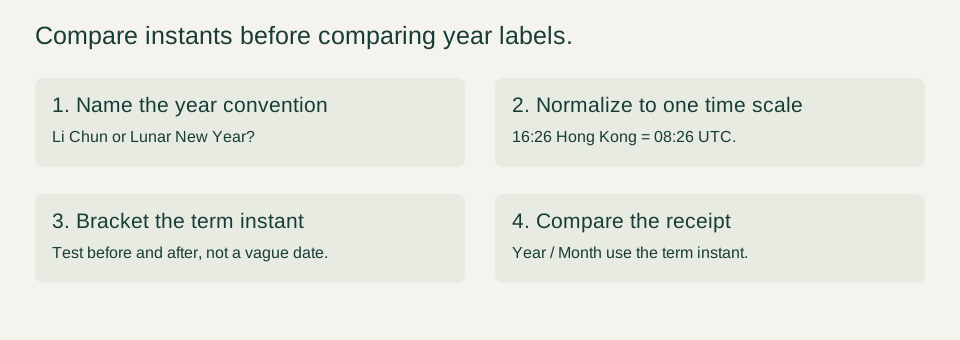
This distinction prevents a misleading comparison: the adjusted display at the later input reads 15:51, but comparing that local solar-clock label directly with the term table’s 16:27 label mixes two clock bases. First compare physical instants on one time scale. This is the convention of this implementation, not a claim that all calculators or schools use the same clock rules.
What happens between Li Chun and Lunar New Year?
Our additional February 5, 2024 noon Hong Kong input returned Jia Chen for Year and Bing Yin for Month. It is after the February 4 Li Chun instant but before the February 10 Lunar New Year date shown by the Observatory. This one reproducible case explains why a Bazi Year label may differ from a lunar-calendar or popular zodiac year label without either label alone proving a software bug.
The first thing to ask is which boundary a particular display claims to use. Do not change the birth date to force two year labels to agree. A lunar-calendar conversion, a popular zodiac label and this calculator’s Year pillar can answer different questions. For lunar input, verify the converted Gregorian date and leap-month selection first.
Quick answers
Is the whole of February 4 the new Bazi year?
Not under this instant-based rule. Our 16:26 and 16:28 examples on the same date have different Year pillars. The time of the event matters.
Is Li Chun always at this time?
No. The 2024 timestamp is one dated example. Look up the term for the birth year rather than copying this clock time into another year.
Can I ignore an unknown birth hour?
Not near this boundary. The two possible Year/Month pairs in our table occur on the same date. Keep the hour unresolved and follow the unknown-time limitations rather than treating a noon reference as recovered evidence.
Which calculator is wrong if year labels differ?
Match the date, calendar, time zone and stated year rule before judging. If both claim the same rule and instant, compare the term source and precision. A discrepancy is a case to inspect, not evidence that predictive claims are validated.
Reproduce the boundary audit
The raw synthetic test ledger provides all seven inputs, UTC receipts, adjusted clocks, pillar outputs and the library’s term timestamp. Assertions checked equal UTC instants across zones, Year/Month stability under the solar toggle, and the two bracketing outcomes. These are sampled behavior checks, not a complete ephemeris accuracy assessment or a validation of predictions.
- Hong Kong Observatory: February 2024 calendar — Spring Commences time and Lunar New Year date.
- HKO Almanac 2024 index — original calendar and solar-term references.
- Calendar engine source — bundled version 1.7.7 and term table.
- Our disclosed calculation conventions — UTC+08 Year/Month basis and local Day/Hour treatment.