ONE CHART. TWO DIFFERENT QUESTIONS.
Why do Five Elements counts differ from Bazi strength?
An element count records appearances. A strength score applies weights and compares support for the Day Master. They are not interchangeable. In our synthetic test, Earth has no visible character but appears in hidden stems and contributes to the support score.
The same chart, counted three ways
We entered June 15, 1990 at 12:00, Gregorian calendar, Asia/Shanghai, longitude 116.39723° east, true solar time OFF, midnight day boundary, known hour, male. These are fabricated test settings, not a person’s birth record. Time-zone history still applies when true solar time is off.
The calculator returned Geng Wu / Ren Wu / Xin Hai / Jia Wu in Year–Month–Day–Hour order. Xin Metal is the Day Master. You can reproduce the numbers below with the same inputs, then open the calculation receipt. Changing true solar time or the hour means you are testing a different chart.
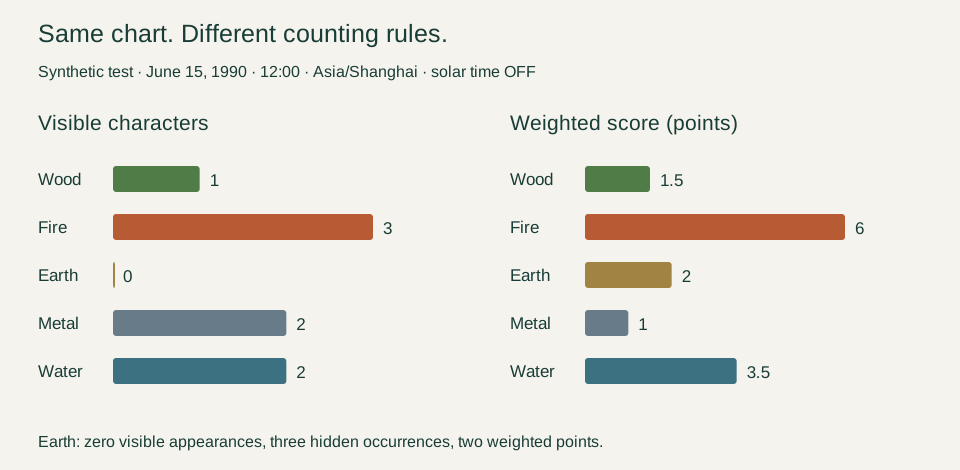
| Scope | Wood | Fire | Earth | Metal | Water | Total |
|---|---|---|---|---|---|---|
| Visible characters | 1 | 3 | 0 | 2 | 2 | 8 |
| Hidden-stem occurrences | 1 | 3 | 3 | 0 | 1 | 8 |
| Weighted score (points) | 1.5 | 6 | 2 | 1 | 3.5 | 14 |
The first row counts each visible stem once and each branch by its assigned main element once: eight characters, eight appearances. The hidden row counts the additional stem entries listed inside the branches. It is a separate inventory, not eight more visible characters. The weighted row uses the site’s disclosed scoring convention; it is not a percentage of physical energy.
Why zero visible Earth does not mean no Earth
| Pillar | Visible stem | Branch main element | Hidden stems |
|---|---|---|---|
| Year · Geng Wu | Geng · Metal | Wu · Fire | Ding · Fire; Ji · Earth |
| Month · Ren Wu | Ren · Water | Wu · Fire | Ding · Fire; Ji · Earth |
| Day · Xin Hai | Xin · Metal | Hai · Water | Ren · Water; Jia · Wood |
| Hour · Jia Wu | Jia · Wood | Wu · Fire | Ding · Fire; Ji · Earth |
Our full chart has three Wu branches. Each lists Ding Fire and Ji Earth as hidden stems. That gives Earth three hidden occurrences despite zero visible appearances. This is a statement about the displayed symbols and counting scope, not evidence of a personal deficiency or a reason to buy a remedy.
Do not add the visible and hidden inventories and then call the result “the eight characters.” You have changed the scope. A comparison between calculators is useful only after both specify whether their chart includes stems, branch main elements, hidden stems, or weighted combinations.
Reconstruct the score instead of guessing
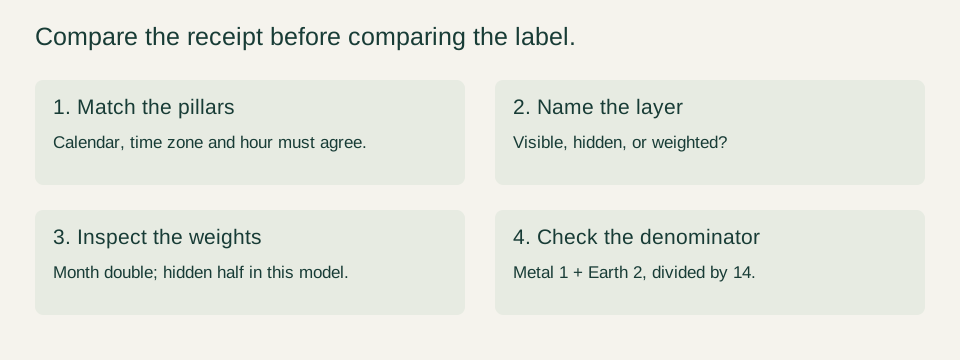
This calculator gives the Month pillar weight 2 and each other pillar weight 1. It includes non-Day-Master visible stems, branch main elements, and every listed hidden stem at half the pillar weight. The Day Master’s visible stem is excluded from the support score’s denominator. These are software conventions in this model, not a universal rule for every Bazi school.
| Pillar | Weighted additions | Points |
|---|---|---|
| Year | Metal 1 (stem) + Fire 1 (branch) + Fire 0.5 (hidden) + Earth 0.5 (hidden) | 3 |
| Month | Water 2 (stem) + Fire 2 (branch) + Fire 1 (hidden) + Earth 1 (hidden) | 6 |
| Day | Water 1 (branch) + Water 0.5 (hidden) + Wood 0.5 (hidden) | 2 |
| Hour | Wood 1 (stem) + Fire 1 (branch) + Fire 0.5 (hidden) + Earth 0.5 (hidden) | 3 |
For Earth, Ji hidden in the Year Wu adds 0.5, in the double-weight Month Wu adds 1, and in the Hour Wu adds 0.5: 0.5 + 1 + 0.5 = 2 points. The three hidden occurrences and the two weighted points describe the same symbols using different rules.
For this Xin Metal Day Master, the model treats Metal and Earth as support. The receipt reads (Metal 1 + Earth 2) ÷ total 14 = 3 ÷ 14 = 21.4% support, rounded to one decimal place. The engine labels ratios at or below 45% “Weaker,” at or above 55% “Stronger,” and values between them “Balanced.” This example therefore reads “Weaker.”
Fire has the largest visible count and the largest weighted total in this example, but “largest element” is not the same question as “support for the Metal Day Master.” A bar chart by itself does not identify a useful element, a special structure, or a transformation. This simple model does not resolve those interpretations.
What changes when the birth hour is unknown?
We repeated the same test with Unknown time selected. The Hour pillar disappeared; visible counts became Wood 0, Fire 2, Earth 0, Metal 2, Water 2, totaling six. The partial weighted score became Wood 0.5, Fire 4.5, Earth 1.5, Metal 1, Water 3.5. Support was 2.5 ÷ 11 = 22.7%. The partial model still reads “Weaker,” but it is a different denominator and not a completed chart.
An unknown-hour result cannot establish that an element is absent from the complete chart. In this controlled comparison, the known Jia Wu hour adds visible Wood and Fire. Keep the missing hour unresolved rather than choosing a convenient time to make the distribution look balanced.
Questions to ask before comparing calculators
Does zero mean missing?
Only within the named scope. Zero in the visible row can coexist with nonzero hidden entries, as Earth does in our test. State “zero visible Earth,” not “no Earth anywhere.”
Is 21.4% an accuracy score?
No. It is this model’s weighted support share, calculated as 3 ÷ 14. It is not confidence, scientific accuracy, or a probability about someone’s future.
Why do two sites disagree?
First compare the actual pillars and input conventions. If the pillars match, compare counting scope, hidden-stem treatment, Month weighting and whether the Day Master is included. Different conventions can produce different numbers without a calendar error.
Should I add the least common element?
The counts alone cannot answer that. This page audits calculation displays; it does not prescribe colours, purchases, treatments or decisions from an element tally.
Reproduce it and inspect the limits
Download our synthetic settings, raw outputs and contribution ledger. The visible and weighted totals were independently reconstructed from the returned pillar entries and matched the unchanged browser engine in both full and partial cases. This checks internal arithmetic; it does not validate traditional predictive claims.
- Our calculation conventions and the calculator’s receipt: local scoring rules, supported range and uncertainty.
- Calendar library source: lunar-javascript; bundled version 1.7.7 supplies the pillar and hidden-stem entries. The support heuristic is separate site code.
- Unknown birth time worked tests: why a partial chart remains partial.
- Daylight-saving worked tests: input conventions can change pillars before scoring begins.