Bazi Calculator and Analysis: What the Reading Actually Uses
The calculation produces the chart; the written analysis is a separate layer. On this site, four fixed-rule paragraphs describe the Day Master, visible elements, recurring Ten Gods and a disclosed support model. They do not recover missing birth information or prove personal predictions. Check the inputs behind each sentence before treating a fluent reading as evidence.
What each paragraph actually reads
The reading function receives a completed result object. It does not ask an online AI service to write a new profile. Its first paragraph uses the Day Master; its second uses visible element counts; its third selects recurring Ten God labels; its fourth follows the strength label. The analysis discussed here is this specific implementation, not a statement about every Bazi website. Source: unchanged calculation and reading code.
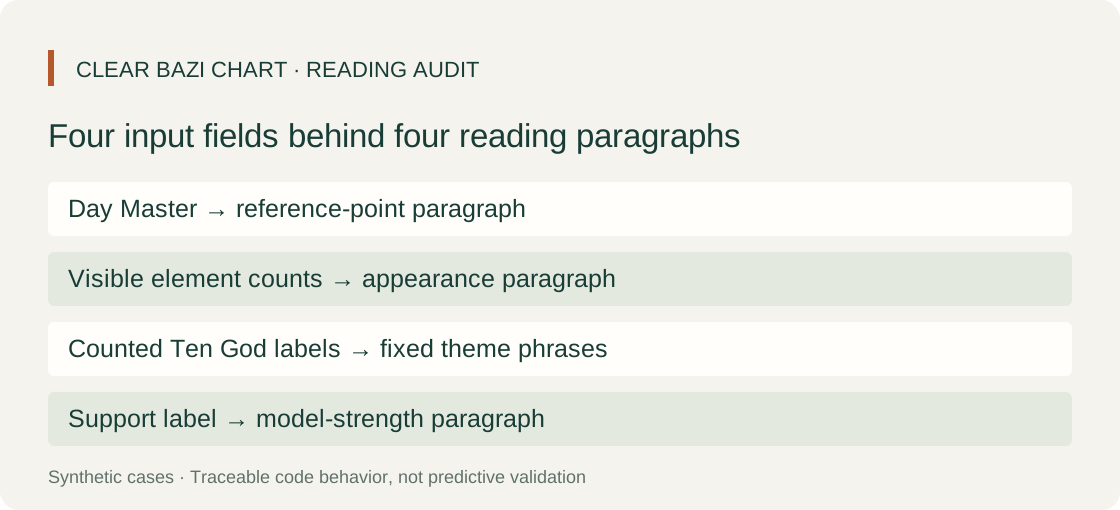
A chart can contain more information than these four paragraphs mention. Hidden stems, luck cycles and the full calculation receipt have their own sections. A short reading therefore is not a complete transcript of the result, and an omitted detail is not automatically absent from the chart. The chart anatomy guide explains where the other fields appear. Source: unchanged calculation and reading code.
One synthetic record, three controlled runs
We used November 8, 1996 at 08:20, Asia/Singapore, longitude 103.8° east, Gregorian calendar, midnight day boundary and solar time OFF. These are synthetic inputs, not a person’s birth record. The first two runs change only the sex selector; the third keeps the male selection and marks the hour unknown. Yesterday’s prepared input seeds were rendered and checked today in the browser. three-case reading ledger.
| Check | Known, male | Known, female | Unknown hour, male |
|---|---|---|---|
| Pillars | Bing Zi / Ji Hai / Ji You / Wu Chen | Bing Zi / Ji Hai / Ji You / Wu Chen | Bing Zi / Ji Hai / Ji You |
| Support / total | 5.5 / 13.5 | 5.5 / 13.5 | 3 / 10 |
| Support percentage | 40.7% | 40.7% | 30.0% |
| Luck direction | Forward | Backward | Forward (provisional) |
The two known-time runs return Bing Zi / Ji Hai / Ji You / Wu Chen, with a Yin Earth Day Master. All four reading paragraphs are byte-identical in the browser, even though luck direction changes from forward to backward. The exact paragraph comparison shows that this reading function is not personalizing its prose from the sex selector. It does not show that every output on the page is identical. three-case reading ledger.
Luck onset also differs in this controlled pair: 9y 7m 9d 12h in the male run and 0y 3m 14d 12h in the female run. Those are the engine’s onset intervals, not promises about real-life events. The reading text remains the same because the fixed paragraphs do not consume those onset fields. Keep the luck section separate when checking what a piece of prose is actually using. three-case reading ledger; unchanged calculation and reading code.
The element sentence is a count statement
In the known-time example, the visible count is Wood 0, Fire 1, Earth 4, Metal 1 and Water 2. The reading therefore identifies Earth as the most frequent visible element. That sentence is traceable to the count object; it is not an independent diagnosis of character, health or balance. The statement about missing Wood is specifically about visible characters. three-case reading ledger.
The weighted support calculation is separate: 5.5 support divided by 13.5 total, multiplied by 100, gives 40.740740…%, displayed as 40.7%. The model classifies that result as Weaker, and the last paragraph follows that label. Here the most frequent visible element and the support label describe different calculations. The numerator and denominator come from the exact same known-time run. three-case reading ledger.
For the full weighting definition and a different worked example, see visible element counts versus strength. Repeating a label in fluent prose does not add another independent measurement. It is still the label produced by the disclosed model, whose transformation and special-structure limitations remain in the reading. Source: unchanged calculation and reading code.
Recurring labels do not imply a unique personal profile
The known-time ledger contains two occurrences each for Indirect Wealth and Rob Wealth in the counted stem labels. The generated third paragraph selects those labels and attaches the corresponding fixed theme phrases. The occurrence count supports which labels were selected; it does not test whether the theme phrases accurately describe a real person. Both the counted labels and the exact generated wording are preserved in the ledger. three-case reading ledger.
With the hour unknown, six counted Ten God labels tie at one occurrence each. The implementation orders them by count and selects the first two in the resulting list: Direct Resource and Indirect Wealth in this case. A tied list is not evidence that those two are more important than every other tied label. This particular selection can be traced to the stored ordering rather than invented psychological certainty. three-case reading ledger; unchanged calculation and reading code.
What changes when the hour is unknown?
The unknown-hour run supplies three pillars: Bing Zi / Ji Hai / Ji You. Visible Earth drops from 4 to 2, while Water remains 2, so the second paragraph now describes a tie. Support becomes 3 divided by 10, multiplied by 100, or 30.0%. The final paragraph explicitly refers to the known three pillars. These changed sentences reflect changed available inputs, not a successful reconstruction of the missing hour. three-case reading ledger.
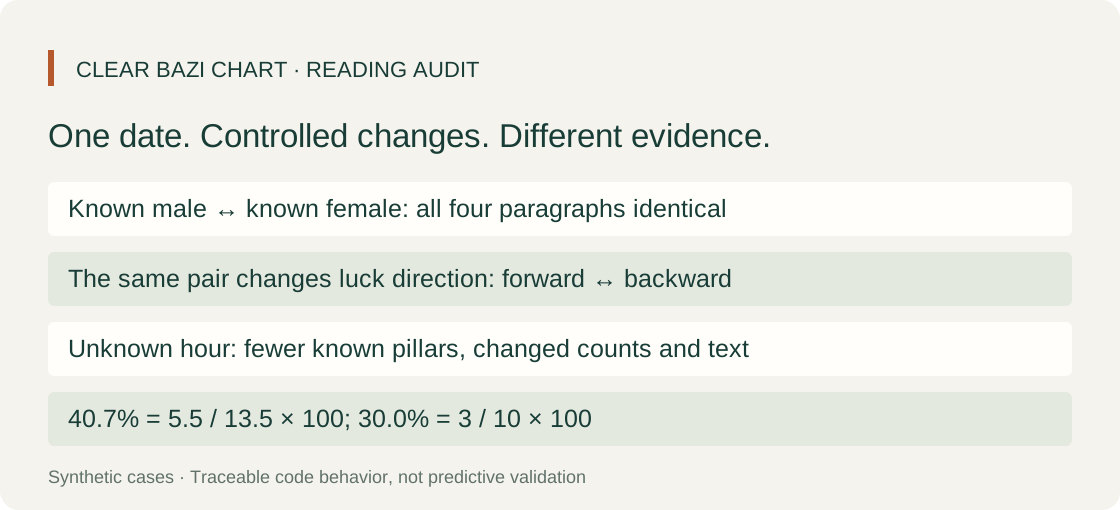
Unknown-time mode uses a noon reference and sampled times to disclose possible chart variation. Its strength, onset and current-cycle labels are provisional. A polished paragraph cannot remove that uncertainty. Keep the missing-hour status attached when copying or discussing a partial reading, and use the unknown-time test page for the sampling limits. Source: unchanged calculation and reading code.
Four generated paragraphs, with their input trail
Yin Earth is the reference point. Every Ten God in this chart describes a relationship to your Ji Day Master; it is not a stand-alone personality label.
Earth appears most often. Wood is absent from the visible count, but hidden stems are listed separately. An absent element is not automatically a deficiency.
Indirect Wealth + Rob Wealth recur in the stem labels. Traditional associations connect this combination with opportunity, variety and practical resourcefulness, alongside initiative, competition and negotiating shared resources. Consider these as prompts for reflection, not guaranteed traits.
The support model reads weaker. Peer and Resource elements contribute a smaller share of the weighted tally. The balancing school traditionally looks toward support and reinforcement. This model does not resolve special structures or transformations.
Can the written analysis tell me which calculator to trust?
The prose alone cannot establish that the clock conversion or calendar input was correct. First inspect the calculation receipt, then trace the analysis to the fields it consumes. Our existing answer to the reader’s calculator-recommendation question covers the clock checks; this page covers the later reading layer. The distinction keeps a readable explanation from being mistaken for an independent accuracy test. Source: unchanged calculation and reading code.
Does this analysis use an online AI service?
No. For this implementation, renderReading selects text locally from fixed strings and computed labels. The page does not request an AI-generated profile. That describes a software workflow; it does not establish scientific validity for traditional interpretations. Other calculators can use different workflows, so inspect their actual descriptions rather than assuming that every automatic reading is either AI-written or identical to this one. Source: unchanged calculation and reading code.
A repeatable way to inspect your reading
Keep the birth inputs and uncertainty settings with the result. Read one paragraph at a time, identify its source field, and change only one input when comparing outputs. Use the visible counts for the count sentence and the disclosed weighted numerator and denominator for the support sentence. A test that leaves prose unchanged is still informative when another result field changes. The complete controlled inputs and exact output paragraphs are in the three-case reading ledger.